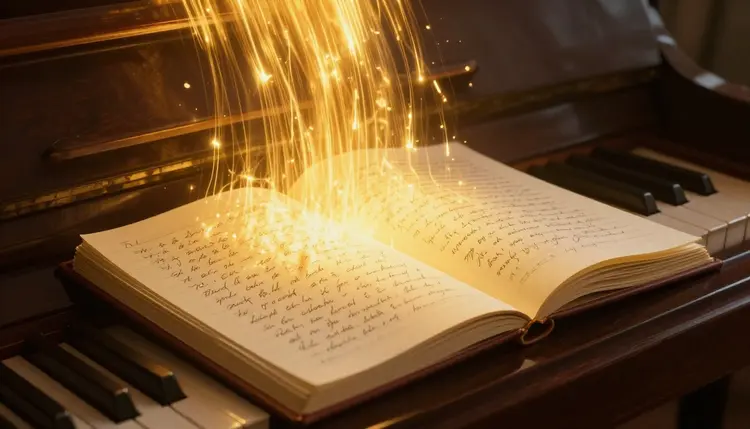
You have a verse and a chorus sitting in a notes app, and until now the only way to know if the song worked was to sing it yourself or pay a studio for a rough demo. AI music generation collapses that step: paste the lyrics, name a genre and mood, and hear them sung over instrumentation in minutes, before anyone else hears the idea.
The model takes the words you write and does three things at once: it composes a melody that fits the syllables and phrasing, generates a sung vocal to carry that melody, and builds instrumentation underneath in whatever genre you specified. One generation produces the whole track, words, voice and music, from the lyrics alone.
What you should expect from that is a demo, not a master. A generated track tells you convincingly whether a chorus lands, whether the verse-to-chorus lift works, and whether the words scan the way you heard them in your head. It will not replace a human vocalist's phrasing, a real drummer's pocket, or a mix engineer's ear, and it is not trying to. Think of it as a fast, honest gut check on an idea, done before you spend a studio day finding out the bridge does not work.
On Picasso IA, generation happens in the Toolkit with any of the music models in the catalog. You paste or type the lyrics, pick a genre and mood, and generate. New accounts start with free credits, so the first few passes at a song cost nothing but the time it takes to listen back.
A single mood word gives the model very little to work with. "Sad song" could become a folk ballad, a slow R&B track or a minor-key piano piece, and you will not know which until you spend a generation finding out. Naming an actual genre, a tempo feel and a couple of instruments narrows that space enormously, because the model has strong associations for genre labels that vague mood words do not carry.
The difference in practice is concrete. "A slow, acoustic folk ballad, fingerpicked guitar, brushed drums, a weary but hopeful vocal" gives the model a genre, an instrumentation list and a vocal direction in one line, and the result sounds like that description rather than like a guess. Compare that to just "make it emotional," which leaves every one of those decisions to chance. The more concrete the genre and instrumentation, the less variance between takes, which matters when you are judging the lyrics rather than the randomness.
Pro tip: describe the chorus and verse energy separately if they differ, for example "verse is sparse and half-spoken, chorus opens up with full drums and layered vocals." Generic prompts tend to flatten a song to one dynamic level throughout, and dynamics are often exactly what makes a chorus feel like a chorus.
There are two different jobs a generated track can do, and confusing them leads to disappointment. The first is testing an idea: does this melody work over these words, does the song have a shape, is it worth finishing. For that job a generated track is genuinely useful, turning an abstract lyric sheet into something you and a collaborator can actually react to together.
The second job, a finished release, is different. A track meant for release usually still goes through a human vocalist, a mix and mastering, with the generated version serving as a reference for tempo, key and arrangement rather than the final master. Some artists do release generated vocals as-is, and that is a legitimate choice, but it is a choice, not the default outcome of the workflow.
Where this matters most is commercial use. If a track ends up in a video, a game, or a release you plan to sell, check the platform's licensing terms for that specific use before you publish. A generated instrumental without vocals also works well as background music for a video once you drop the lyrics entirely.
Not every genre translates the same way from a lyric sheet to a generated track. Genres built around a clear melody line and simple word delivery come through cleanly, while genres that depend on tight vocal-instrument interplay or rapid-fire phrasing ask more of the words you feed in.
| Genre | What tends to come through clearly | What to watch |
|---|
| Acoustic / folk | plain-spoken lyrics, a steady melodic line, simple imagery | works best with fewer, unhurried words per line |
| Pop | a strong, repeatable hook line and a clear verse-chorus contrast | the chorus lyric carries most of the weight, keep it short |
| Hip-hop / rap | rhythmic phrasing and internal rhyme, if the syllable count is consistent | uneven syllable counts across bars are the most common failure |
| Ballad | emotional pacing, space between lines, a strong closing line | rushed lyrics lose the slow build a ballad depends on |
Run the same lyrics through two genres before deciding the song does not work. A verse that feels flat as a pop track can land completely differently as a ballad, because the genre changes the pacing and the space the melody gives each line, not just the instrumentation.
An honest tool page says where the workflow breaks, and lyrics-to-music has real limits worth knowing before you spend a generation on something that was never going to work.
- Bad scansion stays bad: the model follows the words you give it, so a line with an awkward syllable count or a rhyme that does not quite land still sounds awkward set to music.
- The voice is synthetic, not yours: generated vocals are a specific AI voice built into the model, not your own singing voice or a hired session vocalist, and it cannot be made to sound like a particular real person.
- Commercial use needs a licensing check: selling, monetizing or distributing a generated track commercially means reading the platform's licensing terms for that use case first.
- Long-form structure is unreliable: a track with a bridge, a key change and three distinct sections asks more of the generation than a straightforward verse-chorus-verse, and complex arrangements more easily lose the plot.
- Every generation is a fresh take: two runs of the same lyrics and genre prompt will not produce the same melody twice, so you cannot regenerate a single missed line without the rest of the take shifting too.
None of this makes a generated track less useful as a demo; it defines what the demo is for, telling you fast whether a song is worth a studio day. If you have already looked at dedicated music generators, the Suno comparison covers how a single-purpose tool differs from a catalog that also handles image, video and 3D.
The process from a finished lyric sheet to a listenable track usually takes one afternoon, most spent listening back and adjusting. Credits are only spent on generation, so check what a run costs on the pricing page first.
- Finalize the lyrics and read the syllable flow out loud. Say each line at a natural speaking pace before you generate anything; a line that trips your own tongue will trip the model's phrasing too.
- Choose a genre and write a specific mood description. Name the genre, a tempo feel and one or two instruments, rather than relying on a single mood word to carry the whole direction.
- Generate the track in the Toolkit. Paste the finalized lyrics with the genre and mood description, and let the model produce the melody, vocal and instrumentation together.
- Listen critically for anything that scans oddly. Note the exact line or section where the phrasing feels forced, since that is almost always a lyric problem surfacing rather than a generation problem.
- Regenerate or hand-edit the flagged lyrics and try again. Adjust the syllable count or word choice on the problem line, then generate again; most songs need two or three passes before the phrasing settles.
Can AI really turn written lyrics into a full song?
Yes. The model reads the lyrics you provide and generates a melody, a sung vocal and instrumentation together, in the genre and mood you specify, so the output is a complete track rather than a beat or a backing loop. What it produces is a demo-quality version of the song, useful for hearing whether the idea works, rather than a fully mixed and mastered release, and most songwriters use it as the fastest gut check on a set of lyrics before committing more time to the song.
Do I need to write the lyrics myself first?
Yes, you provide the lyrics; the model sets them to music rather than writing them for you. The words, the rhyme scheme and the syllable count in each line are your decisions, and the quality of the track depends heavily on how well those lyrics scan when spoken aloud. If a line is awkward on the page, expect it to sound awkward sung as well.
How specific does my genre and mood description need to be?
More specific gets you a more predictable result. A single word like "happy" or "sad" leaves the model to guess at genre, tempo and instrumentation, and you get a wide range of outcomes across runs. Naming an actual genre, a tempo feel and one or two instruments, such as "upbeat acoustic pop, driving guitar, light percussion," narrows that range and gets you closer to what you imagined on the first or second try.
Will the generated vocal sound like my own voice?
No. The generated vocal is a synthetic voice built into the model, not a recording or clone of your own singing or anyone else's. If you need the final vocal to be your actual voice, the generated track works better as a reference for melody and phrasing that a human vocalist then performs, rather than as the final vocal take itself.
Can I use a generated song commercially?
Check the licensing terms for your specific use before you publish or monetize a generated track, since rules vary depending on how it will be used, such as in a video, a game or a paid release. Picasso IA does not set those terms itself; the applicable licensing sits with the platform and the specific use case, so confirming it before commercial release is worth the few minutes it takes.
Why does my rap verse sound off even though the lyrics rhyme?
Rhyming words are not the same as a consistent syllable count, and rap phrasing depends heavily on both landing together. If one bar has ten syllables and the next has fourteen, the model has to compress or stretch the delivery to fit the beat, and that stretching is usually what sounds off rather than the rhymes themselves. Counting syllables per bar and evening them out before generating is the most effective fix for rap lyrics that feel rushed or dragged.
Can I regenerate just the chorus without changing the verses?
Each generation produces the whole track as one pass, so a fresh generation on the same lyrics varies the entire song, not just the section you wanted to change. The practical workaround is to generate several full takes and pick the one where the section you care about, often the chorus, lands best, rather than trying to patch one section of a single take.
Is there a limit to how long the lyrics can be?
Very long lyric sheets, several verses plus multiple choruses and a bridge, ask more of a single generation than a compact structure does, and results tend to hold together better on shorter, focused lyrics. If you have a longer song, generating it in sections, verse and chorus first, then the bridge separately, often gives more usable results than one pass on the whole sheet.
What should I do if the melody does not match the emotion of the lyrics?
Adjust the genre and mood description before touching the lyrics themselves, since the melody responds directly to those instructions. A verse about loss generated with an upbeat, high-energy mood description fights itself no matter how the words are written, while the same lyrics with a slower tempo and restrained instrumentation usually resolve the mismatch. Only rewrite the lyrics if the mood description alone does not fix it.
Do I need any music production experience to use this?
No. Writing lyrics that scan reasonably well when read aloud, and knowing roughly what genre you want, is enough to get a usable demo. You do not need to play an instrument, program a beat, or use a digital audio workstation, since the model handles composition and instrumentation from your description. Production experience helps you write sharper prompts, but it is not a requirement to start.
Your lyrics are already written down somewhere, and hearing them as a real track costs nothing but a few free credits. Open the Toolkit and generate the first version before you decide whether the song is finished.