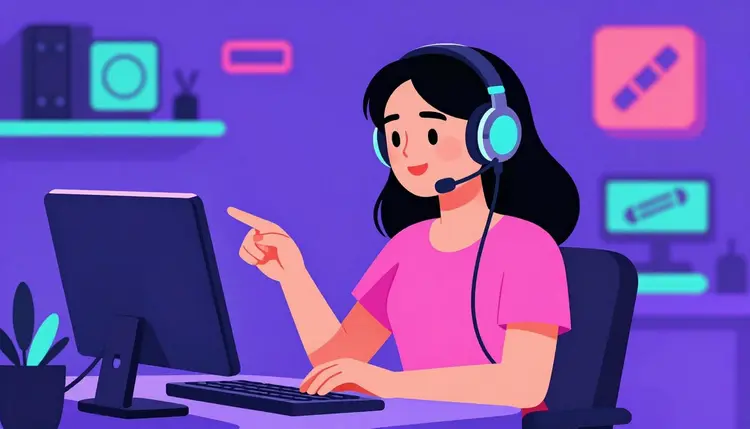
Building a streaming persona or a VTuber avatar is part costume design, part branding, and increasingly part illustration project. Once a channel grows, creators start commissioning alert art, subscriber badges, emotes, and reference sheets for a character that only exists as a drawing. Some of that art, for the platforms and audiences where it is allowed, is meant to be adult. That is where most AI image generators get in the way: almost every model applies a content filter that scans the prompt and refuses anything read as explicit or suggestive, whether or not the subject is a fictional drawing.
Picasso IA hosts 488 models, and only a small number are confirmed to generate adult content directly, without a safety filter interrupting the generation. Recraft V4.1 Pro is one of them. You can open it directly at Recraft V4.1 Pro, or reach it from the toolkit, where it sits alongside every other image and video model on the platform.
What makes it a specifically good fit for a streaming or VTuber persona is not just that the filter stays out of the way. It is a model built for illustration and character work rather than photorealism, which is closer to what most streaming personas actually look like: a drawn mascot, an anime adjacent avatar, a stylized alter ego with a consistent color palette and silhouette. When the goal is a character sheet, an emote pack, or a themed alert image rather than a single throwaway picture, that consistency across generations matters more than raw photorealistic detail.
This page explains what the model actually does, how to use it well for this purpose, and where the real limits sit. It is about pointing to the tool built for this job, not about getting around a filter on a different one.
Recraft V4.1 Pro is a text-to-image model, so every result starts from a written prompt describing the character, the pose, the outfit or lack of one, the setting, and the art style. Its real strengths, based on what it actually produces, are clean vector-like and painterly illustration styles, sharp line art, and strong control over color and composition. It handles stylized anime, semi-realistic digital painting, and graphic-design layouts, think overlay panels, badge frames, and poster-style compositions, noticeably better than it handles photoreal skin and lighting.
For a fictional adult streaming persona, that translates into a few concrete use cases: a full-body reference sheet for a character in and out of costume, a set of alternate outfits or skins for the same mascot, suggestive or explicit solo artwork of an original character, and stylized cover art for a members-only post or subscriber tier. It is not a photorealistic face tool and it does not attempt to recreate a real person; it generates original, drawn-style imagery from a text description, which is exactly the kind of asset a persona built around a drawn avatar actually needs.
If a project calls for a different look, such as a photoreal render or a short video clip, the same rule still applies: only Seedream 4.5, Qwen Image 2, Picasso Image Editor Pro, Picasso Video, and LTX 2.3 Pro are confirmed to generate adult content without a filter stepping in. An unfiltered result should come from one of these six, not from guessing.
The workflow inside Picasso IA for turning an idea into a finished piece of persona art is the same five steps every time, whether the output is a single illustration or the first page of a full reference sheet.
- Open Recraft V4.1 Pro in the toolkit. Head to the toolkit and pick Recraft V4.1 Pro from the model list to start a new generation.
- Describe the character in detail. Write out who the character is, their build, hair, outfit or state of undress, and the art style you want, since the model follows a detailed prompt far more closely than a short, vague one.
- Set the pose and framing. Specify full body, half body, or a close crop, and describe the pose directly instead of leaving it to chance, since pose language has the biggest effect on how usable the result is for an overlay or a badge.
- Generate and review multiple variations. Run the same prompt a few times and compare results side by side, since even a strong, specific prompt still produces some variation between generations.
- Refine with a follow-up prompt. Adjust color, outfit details, or background directly from a result instead of starting over each time, and save the version that actually matches the persona once it looks right.
Five images or so, following that loop, is usually enough to land on a version worth keeping as the character's canonical look, the one referenced in every prompt after that.
A few habits make a real difference in how usable the output is, beyond just running the five steps above once and hoping.
Keep the character description consistent across every prompt. If the persona has purple hair, a specific horn shape, or a particular collar, use the exact same phrase for it every time rather than rewording it, since small wording changes are enough to shift the design between generations. Treat that phrase like a character sheet entry and reuse it.
Name the art style explicitly instead of describing a vague mood. "Anime cel-shaded illustration" or "painterly digital art" gives the model something concrete to match, and it responds far better to a named style than to adjectives like "cool" or "aesthetic."
Describe lighting and background on purpose, even for a simple piece. A plain studio background with soft rim lighting reads very differently from a neon-lit room, and leaving it out means the model fills in a default that may not fit the rest of the persona's branding.
Be direct about pose and framing rather than implying it. "Standing, three-quarter view, hand on hip" produces a more reliable result than a prompt that only describes the character and hopes the pose comes out right on its own.
Finally, treat the first result as a draft. Reusing the character description while adjusting one variable at a time, outfit, pose, or background, gets to a usable final image faster than rewriting the whole prompt from scratch after every attempt.
This is the part that matters most, stated plainly: every character generated for this purpose must be fictional. Picasso IA does not generate adult content depicting a real person, a public figure, or anyone whose likeness is recognizable as a specific real individual, and it never generates content depicting or resembling a minor, under any framing. This applies to Recraft V4.1 Pro and to every other model on the platform, with no exceptions. A streaming persona or VTuber avatar is, by definition, an original character, and that is the only kind of character this workflow is meant to produce.
It is also worth understanding the mechanic honestly. Most models on Picasso IA, outside the six confirmed ones, apply a content filter that can refuse a prompt read as explicit. When that happens, the app shows a message that the content is not supported by that model and recommends switching to one of the six confirmed models instead, carrying the same prompt over automatically so nothing has to be retyped. That is the intended path: switch to a model built for the job, rather than reword or disguise a prompt to slip past a filter on a model that was never meant to generate that content.
Streamers and VTubers should also check the rules of whichever platform they plan to post or sell the art on. Twitch, Discord, Patreon, and similar platforms each set their own limits on adult content, age-gating, and where it can be shared, and those rules sit entirely outside of Picasso IA. Generating an image here does not clear it for posting anywhere a platform's own terms say otherwise.
Recraft V4.1 Pro is available through the same credit system as every other model on Picasso IA. New accounts get free credits to try image generation, including Recraft V4.1 Pro, before deciding whether to subscribe. Every plan and its current credit allowance, along with what a generation on this model costs, is listed on the pricing page rather than repeated here, since plans and allowances change and the pricing page is always the current source.
For someone building out a full persona, meaning a reference sheet, several outfit variants, and a set of alert or badge art, the more relevant number is how many generations it realistically takes to land on keepers, not just the cost of one image. Budgeting for several generations per finished piece, per the refinement process described above, gives a more accurate picture than pricing out a single perfect result on the first try.
Is Recraft V4.1 Pro really uncensored for adult content?
Recraft V4.1 Pro is one of six models on Picasso IA confirmed to generate adult content directly, without a safety filter blocking the prompt first. It is not a jailbreak or a workaround; it is a model that natively supports this kind of generation, unlike most other models on the platform.
Can I generate a real person or celebrity in an NSFW image?
No. Picasso IA does not generate adult content depicting a real person, a public figure, or anyone recognizable as a specific real individual, on Recraft V4.1 Pro or on any other model. This workflow is exclusively for original, fictional characters.
What happens if I try NSFW prompts on a different model and it gets blocked?
Most models outside the six confirmed ones apply a content filter that can refuse a prompt read as explicit. When that happens, the app shows a message that the content is not supported by that model and offers to switch to one of the six confirmed models, carrying the prompt over automatically so it does not need to be retyped.
Which other models can generate adult content besides Recraft V4.1 Pro?
The other five confirmed models are Seedream 4.5, Qwen Image 2, Picasso Image Editor Pro, Picasso Video, and LTX 2.3 Pro, the last two for video rather than still images.
Is Recraft V4.1 Pro better for anime style or realistic style?
Its real strength is illustration and painterly styles, including anime and semi-realistic digital painting, along with clean line art and graphic layouts. It is not built primarily for photoreal skin and lighting, so a fully photorealistic result is better suited to a model like Seedream 4.5.
How do I keep a character's design consistent across multiple images?
Write out the character's defining details, hair, build, outfit pieces, colors, once as a fixed description, and reuse that exact phrasing in every prompt for that character rather than rewording it each time. Small wording changes shift the design more than expected between generations.
Can I use this for VTuber emotes and alert overlays, not just full artwork?
Yes. Describing a close crop or half-body framing instead of a full body pose works well for emotes and small alert graphics, and the same character description can be reused across a whole emote set to keep the look consistent.
Do I need a paid subscription to try this?
No. New accounts receive free credits that can be used to try Recraft V4.1 Pro and other image models before subscribing. Current credit allowances and plan details are on the pricing page.
Is there an age restriction on generating this kind of content?
Yes, this workflow is for adults generating adult content depicting fictional adult characters only. Content depicting or resembling a minor is never generated, under any framing, on Recraft V4.1 Pro or any other model on the platform.
Where can I see every model available, not just the ones for adult content?
The full catalog lists all 488 models on Picasso IA across text-to-image, image-to-video, 3D generation, background removal, upscaling, and more, alongside the six confirmed for direct adult content generation.