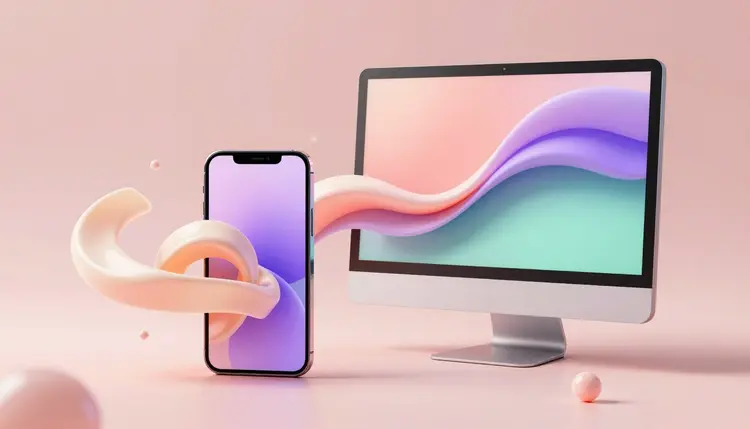
Most wallpapers people end up with were never actually made for their screen. A photo shot for Instagram gets stretched into a desktop background, or a widescreen render gets center-cropped until the subject is half gone on a phone. An AI wallpaper generator skips that compromise entirely: you tell it the mood and the exact aspect ratio, and it builds the image to fit, instead of asking you to fit the image.
A stock wallpaper site gives you what everyone else already has. A generated one is built around a single sentence you wrote, which means the palette matches your icon theme, the composition leaves room for your clock widget, and nobody else's lock screen looks like yours. Text-to-image models are well suited to this because a wallpaper brief is a short, visual request, a subject or an abstract pattern plus a mood plus a color palette, exactly the kind of input these models were trained to satisfy.
Picasso IA runs 488 models behind one interface, including FLUX, Seedream and nano banana, so the same idea can be tested across engines that render color, light and abstract shapes differently; the full catalog is browsable if you want to see what else is available. New accounts get free credits, enough to generate a first batch and see whether a direction is worth pursuing before spending anything.
The single most common wallpaper mistake is generating a square or landscape image and hoping it crops well later. It rarely does, because the subject that looked centered in a 1:1 preview ends up pushed to one edge once a phone's tall 9:16 screen cuts into it. Setting the aspect ratio before you generate, not after, is what actually solves this.
| Format | Aspect ratio | Typical resolution | Best for |
|---|
| Phone (portrait) | 9:16 | 1080x1920 or higher | Lock screen and home screen on most phones |
| Desktop (widescreen) | 16:9 | 1920x1080 up to 3840x2160 | Laptop and standard monitor backgrounds |
| Ultrawide monitor | 21:9 | 3440x1440 | Curved and cinema-style monitors |
| Square | 1:1 | 2048x2048 or higher | Centered lock screen art or a tiled preview |
| Tablet (portrait) | 3:4 | 1620x2160 | iPad and Android tablet home screens |
Models like nano banana 2 and Seedream 4.5 both expose aspect ratio as a direct setting rather than something you fix afterward, with nano banana 2 offering 15 preset ratios including 9:16 and 16:9, and Seedream 4.5 rendering straight to 2K or 4K at nine ratios. FLUX Dev covers 11 ratios from square to 21:9 ultrawide. Pick the ratio that matches the screen you are actually decorating, and the composition comes out built for it.
Wallpapers are unusual prompts because the image has to work as a background, not as a subject that demands attention. A few habits separate a wallpaper that looks good in a generation preview from one you will still like after a week of staring at it behind your app icons.
- Name the mood before the subject: "calm, foggy mountain ridge at dawn" reads differently to a model than "mountain ridge," and steers the palette and lighting toward something you can live with daily.
- Leave room for icons and widgets: ask for negative space or a simple gradient section, top or bottom, so your clock, notifications and dock have somewhere plain to sit.
- Commit to two or three colors: a tight palette like "cream, peach and dusty lavender" produces a wallpaper that matches your icon theme, where an open-ended prompt often does not.
- Say the orientation in words too: pairing the aspect ratio setting with a phrase like "vertical phone wallpaper" or "wide desktop background" reinforces the composition the setting alone sometimes misses.
- Avoid busy focal points near the center: a wallpaper with a single strong subject dead center fights with app icons; an off-center or symmetrical composition holds up better in daily use.
This walkthrough runs entirely inside the Picasso IA toolkit and produces a finished, correctly sized wallpaper in a few minutes, including the upscale pass.
- Decide the format first. Pick phone, desktop, tablet or all three before writing anything, since the aspect ratio you choose shapes the composition the model generates, not the other way around.
- Write a short mood-plus-palette prompt. Combine a subject or abstract pattern, a lighting cue and two or three colors, then set the matching aspect ratio in the model settings.
- Generate a batch and compare. Run the same prompt through a model like nano banana 2, Seedream 4.5 or FLUX Dev, and generate three or four variants so you are choosing between real options instead of settling on the first result.
- Resize the winner for other screens. Feed your favorite output into reframe-image and pick a new aspect ratio; it extends the canvas to match instead of cropping, so the same design becomes a phone and a desktop version.
- Upscale before you set it. Run the final file through an upscaling model so it holds up at full monitor resolution, then download and apply it to your device.
Generating a wallpaper you love once and then wanting it everywhere, phone, laptop, ultrawide monitor, used to mean starting over for each ratio and hoping the second and third generations matched the first in mood and color. Luma's reframe-image model exists specifically for this: it takes a finished image and extends the canvas outward to a new aspect ratio instead of cropping the original down, filling the new space to match the existing scene.
Reframe-image supports seven aspect ratios, 1:1, 3:4, 4:3, 9:16, 16:9, 9:21 and 21:9, and takes an optional prompt to steer how the newly filled areas should look, plus pixel-level positioning so you control exactly where your original image sits inside the new frame. Turn a 16:9 desktop wallpaper into a 9:16 phone version, or a square design into an ultrawide 21:9 monitor background, without regenerating the whole scene and risking a different result.
Before you commit a design to your actual lock screen, open it at real size and imagine your clock, notifications and app icons sitting on top of it. A wallpaper that looks perfect in a generation preview can turn busy or low-contrast the moment real interface elements land on it.
An honest tool page names where the tool stops working, and wallpapers have a few genuine limits worth knowing before you generate a hundred of them.
Generated images typically land between one and four megapixels, which is plenty for a phone screen but can fall short of a genuine 5K or 6K desktop display; an upscaling pass closes most of that gap, but it is an extra step, not something that happens automatically. Legible on-image text, a short quote baked into the wallpaper itself, is still unreliable on general text-to-image models; a dedicated typography-focused model does better with short phrases, though long sentences remain a gamble on any of them. No model previews your actual home screen, so icon placement, widget shapes and notification badges are something you still have to imagine and check by eye once the wallpaper is applied. And reframe-image's extended edges are a believable guess at what should be there, not a record of anything real, so a portrait extended into an ultrawide monitor format can occasionally invent detail at the far edges that reads a little differently from the center of the original.
None of that makes the tool unusable, it just means the fastest workflow is still a human glancing at the result before it becomes a lock screen for the next three months.
Is there a free AI wallpaper generator on Picasso IA?
New accounts get free credits, and a single wallpaper generation is one of the cheaper things to make with them, since a still image costs less than video or 3D output. That is enough to test a few prompts and aspect ratios and land on something you actually want to use. Paid plans exist for heavier use, and since pricing changes over time, the pricing page is the only place worth trusting for current numbers.
What aspect ratio should I use for a phone wallpaper versus a desktop one?
Phone screens are almost universally tall, so 9:16 is the safe default for a lock screen or home screen. Desktop and laptop displays are wide, so 16:9 covers the large majority of monitors, with 21:9 reserved for genuinely ultrawide setups. Setting the correct ratio before generating produces a composition built for that shape, rather than one you crop into it afterward and hope survives.
Can I turn one wallpaper design into both a phone and a desktop version?
Yes, and this is where reframe-image earns its place in the workflow. Generate your favorite design at whichever ratio you started with, then feed it into reframe-image and choose the second aspect ratio you need. It extends the canvas to fill the new shape rather than cropping the original, so both versions keep the same mood, palette and general composition instead of becoming two unrelated images.
Which Picasso IA model should I use for wallpapers?
There is no single correct answer, which is the case for using a catalog instead of one model. Nano banana 2 covers 15 aspect ratios and handles quick iteration well, Seedream 4.5 renders straight to 2K or 4K resolution across nine ratios, and FLUX Dev covers 11 ratios with strong photorealistic and illustrative results. A reasonable session runs the same prompt through two or three of these and keeps whichever output actually matches the mood you described.
How do I make sure my wallpaper looks sharp on a large or 4K display?
Generate at the highest resolution setting your chosen model offers, Seedream 4.5's native 4K output is a strong starting point, then run the result through an upscaling model such as the Google upscaler or Topaz Labs image upscale before applying it. Skipping the upscale step is the most common reason a wallpaper that looked crisp in preview turns slightly soft once it fills an actual large monitor.
Will my home screen icons and widgets cover the best part of the wallpaper?
Possibly, since no generation tool can preview your specific icon layout. The fix is compositional rather than technical: prompt for negative space or a simple gradient section where your clock, dock and notification area typically sit, and avoid putting one dominant subject dead center on a phone wallpaper, since that is exactly where the most icons cluster. Check the result against your actual home screen once before locking it in.
Can I generate a wallpaper with a quote or short text on it?
You can, with a caveat. General text-to-image models like FLUX and Seedream render short words reasonably well but still garble longer sentences often enough that every character needs checking before you use the result. A typography-focused model such as one of the Ideogram versions handles lettering more reliably and is the better starting point when the text matters as much as the background art around it.
Can I use a photo of my own as the starting point for a wallpaper?
Yes. Image-to-image and editing models accept a reference photo alongside a prompt, so you can turn a vacation photo, a piece of your own artwork or an existing wallpaper you like into a new version restyled or resized to fit a different screen. This is also the fastest route to reframe-image, since it needs exactly that, an existing image plus a target aspect ratio.
Can I use AI-generated wallpapers commercially, for example selling wallpaper packs?
Generally yes, and wallpaper packs are a common use of this workflow, but do the same diligence you would for any generated asset: check the license terms attached to the specific model you generated with, and make sure the result does not closely copy a protected design, character or trademark. For personal use on your own devices there is nothing to think about beyond that.
How much does generating a wallpaper cost?
Generations are paid in credits, and the exact cost depends on the model and the resolution you choose, so a specific number here would be wrong within a few months. Still images sit at the cheaper end of the catalog compared with video or 3D generation, and new accounts start with free credits that cover a reasonable first batch. Current plan pricing lives on the pricing page, which stays accurate as prices change.
Your screens deserve a background that was actually built for them. Open the Picasso IA toolkit, pick your aspect ratio, and generate the first version in the next few minutes.