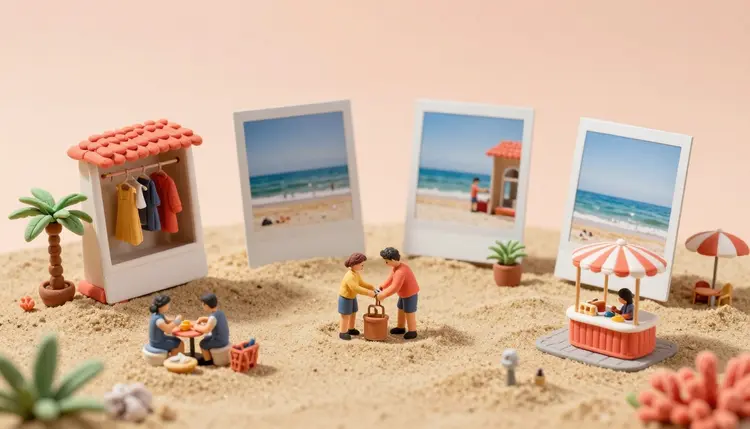
Most AI images start from words alone, and words are a poor way to say this exact person, in that exact jacket, standing in that exact street. Multi-reference generation fixes that by letting you attach several of your own photos at once: one for the person, one for the outfit, one for the place. The model reads them together and paints a single new scene that borrows from each one.
A text prompt can say a woman in a green raincoat on a rainy market street, and the model will invent all three details. That is fine for a stock-photo feel. It stops being fine when the coat is a real one you own, the street is the one outside your shop, and the face is yours. Describing a specific thing in words is slow and lossy; showing it in a photo is one upload.
Reference images also split the job into parts you can swap. Keep the person photo fixed and change the place, or keep the place and try three different outfits. That is the same idea behind consistent AI characters, applied to a whole scene instead of one face. It also pairs naturally with virtual try-on for outfits, where the garment photo is one of the references.
One rule before the how-to: use your own photos, or photos you have the right to use. A person reference should be you, someone who has agreed to it, or a fictional character. Never feed in a real, identifiable person who has not said yes, and never build a scene meant to make someone look like they were somewhere they were not.
Not every image model accepts more than one input photo, and the ones that do disagree on how many. The numbers below come from each model's input settings in the Picasso IA catalog, so they are what the toolkit will actually let you attach.
| Model | Reference photos accepted | Good fit for | Keep in mind |
|---|
| google/nano-banana-pro | Up to 14 | Big scenes with many pieces: a person, several garments, a location, a prop | Output at 1K, 2K or 4K; more references means a longer prompt to keep them straight |
| bytedance/seedream-5-pro | Up to 10 | Blending faces, objects or styles from several photos into one composite | Output at 1K or 2K; prompt limit of 4000 characters |
| picassoia/picassoia-image-editor-pro | Up to 3 | Person plus outfit plus place, since you can call each one image 1, image 2 and image 3 | The first image is the primary one; up to two outputs per run |
| openai/gpt-image-2.5-flare | A list of input images; the catalog describes combining two | Two-photo composites where the prompt carries a lot of instruction | The catalog does not state a cap, so test before planning around more than two |
Three references is exactly what the person, outfit and place recipe needs, so the editor is the natural first try. Reach for nano banana pro when the scene has more ingredients than three, and for Seedream 5 Pro when you want to blend several photos in one go. GPT Image 2.5 Flare is worth a run when your instructions are long and specific. All four sit in the full model catalog next to hundreds of other text-to-image models if you want to compare.
This is the shortest path from three loose photos to one usable image. It assumes you already have the photos on your device.
- Pick one photo for each job. A clear picture of the person, a flat or worn shot of the outfit, and a photo of the place with the light you want. One subject per photo keeps the model from guessing which part matters.
- Open the toolkit and choose a model that fits the count. In the toolkit, pick picassoia-image-editor-pro for three references, or nano-banana-pro or seedream-5-pro when you need more.
- Attach the photos in a deliberate order. The first image is treated as the primary one in the editor, so put the person first, then the outfit, then the place.
- Write a prompt that gives each photo a job. Say what to take from each: the face from image 1, the clothes from image 2, the setting from image 3, then describe the pose and the light.
- Generate, compare and adjust one thing at a time. Look for drift in the face and the garment, change a single line of the prompt, and run again. Credits are spent per run, so check the pricing page before a long session.
The most common reason a multi-reference image looks muddled is a prompt that never says which photo does what. The model sees several pictures and a sentence; if the sentence is vague, it averages them. A prompt that assigns roles gets a much cleaner blend.
On the editor, the references are called image 1, image 2 and so on, and the model's own notes say you can address each one by name. A prompt like this works as a template: dress the person in image 1 with the jacket from image 2, and place her on the street from image 3, keep her face and hairstyle from image 1, soft overcast light, full body, camera at eye level. On models that do not number the inputs the same way, describe each photo by what it shows instead: the person in the first photo, the red jacket in the second.
Tip: say what must stay the same as plainly as what must change. A line such as keep the face, hair and skin tone from image 1 unchanged costs nothing and removes most of the drift people complain about.
Order and wording matter more than length. A few clear sentences that name the sources beat a paragraph of adjectives. If one reference keeps winning, make its role smaller in the prompt (use only the color of the jacket) or crop it so less of the picture competes.
Say you want a portrait of yourself in a jacket you are thinking of buying, standing in front of a market you love. You upload a recent photo of your face and upper body, the product shot of the jacket, and a photo of the market. The prompt names the three jobs, asks for a natural pose, and tells the model to match the light of the place photo.
The first result is rarely the keeper. Expect to adjust the pose, the scale of the person against the background, and how the jacket sits. That is the normal loop, not a failure. The same recipe works for other combinations: your pet plus a costume plus a fantasy backdrop, a product plus a hand model photo of your own plus a kitchen counter, or a character you drew plus a prop plus a landscape. For fashion work with your own garments, the AI fashion model photos page shows the single-subject version of the same idea.
If the picture is going to sell something, keep it truthful: the item in the image should be the item a buyer receives, in its real color and cut. A composite that flatters the product past what it is will cause returns and complaints, whatever the model can draw. Presets that apply a look in one click live in the effects page when you want a finish without writing a prompt.
This method is useful, not magic. These are the places it stops helping.
- Identity drift: faces change a little from run to run and more as the pose or the angle moves away from the reference, so judge likeness at full size before you use a result.
- Fabric and fine print: patterns, logos and small text on a garment get redrawn rather than copied, which makes it a poor way to show an exact print or label.
- Too many ingredients: each extra reference adds a chance the model ignores one, so add photos one at a time instead of loading the maximum on the first try.
- Light and scale mismatch: a person shot in harsh flash will not sit naturally in a soft-light place photo, and a model can put them at the wrong size against the scenery.
- Exact fidelity jobs: a catalog image for a store, a passport-style photo or evidence of any kind needs the real photograph, not a regenerated one.
When a result gets close but a detail is wrong, a second pass with an editing model is usually faster than rerolling the whole scene.
Which AI image models accept more than one reference photo?
In the Picasso IA catalog, nano-banana-pro takes up to 14 reference images, seedream-5-pro up to 10, and picassoia-image-editor-pro up to 3. openai/gpt-image-2.5-flare accepts a list of input images and its description mentions combining two. Many other text-to-image models take one reference or none, so check the model page before you plan a multi-photo scene around it.
How many reference images should I use?
Use the fewest that cover the job. A person, an outfit and a place is three, and that fits every model above. Going to the maximum rarely helps, because each added photo is one more thing the model can ignore or blend wrongly. Start with the essentials, see what comes back, and add a reference only when something specific is missing from the result.
Can I combine a photo of myself with an outfit and a background?
Yes, that is the standard use. Give the photo of yourself as the person reference, a clear photo of the garment as the outfit reference and a photo of the location as the place reference, then say in the prompt what to take from each. Use your own photos, or ones you are allowed to use, and expect to run it a few times to get the pose and scale right.
Do I need to say in the prompt which photo is which?
It helps a lot. On the Picasso IA image editor you can refer to the references as image 1, image 2 and image 3, and a prompt that assigns each a job comes out far cleaner than one that just says combine these. On other models, describe each photo by its content instead, such as the person in the first photo or the jacket in the second.
Will the face in the result look exactly like my photo?
Often close, never guaranteed. Models rebuild a face rather than paste it, so small changes in shape, age or expression can appear, especially when the pose differs from the reference or the face is small in the frame. A sharp, front-facing, well-lit reference helps. If likeness matters for the final image, compare it side by side with the original before you use it.
Can I use photos of other people as references?
Only with their clear permission, or if the person is fictional. Do not use a real, identifiable person without their consent, and do not make images that place someone in a situation they were never in. This is the one rule that does not bend for convenience: it protects other people and it keeps you out of trouble on any platform you publish to.
Is a multi-reference image the same as image-to-image or style transfer?
They are cousins. Image-to-image starts from one photo and changes it. Style transfer copies a look. Multi-reference takes several photos and mixes their content, such as a person from one and a setting from another, into a new image. Some models do all three from the same input field, and the difference is mostly in how you write the prompt.
What if the model ignores one of my references?
Make that photo's job explicit in the prompt, crop the reference so the important part fills the frame, and move it earlier in the order. If it still gets ignored, try a model that accepts more references, or build the scene in two steps: first combine the person and the place, then add the outfit in a second edit with that result as the base.
Can I use these images commercially?
Whether you can depends on the rights to the photos you uploaded and on the terms of the model and the platform where you publish. Your own photos and your own products are the safe starting point. For anything that will be sold, check the platform's current requirements and the model's terms, and keep any product picture truthful about the item.
How much does it cost to generate with several references?
Generations are paid in credits, and the cost depends on the model and the settings you choose, such as resolution and number of outputs, so a number written here would go stale. New accounts get free credits to try it. Current plans are on the pricing page, and a cheap first run at lower resolution is a sensible way to test a prompt.
Ready to try it with your own photos? Open the Picasso IA toolkit, attach your references and see how far one prompt gets you.